Fourth and Toast
a small, playful group for folks who want to communicate better

A tragedy of the modern world is that a lot of interesting people come across as boring. It’s not because they are boring, but because they don’t know how to make their message spark emotions.
We help people fix that.
We all want to be understood.
We all want to explain things just once. We want what we say (in meetings, on social media, in conversations) to stay with people. We all want our ideas to help others, and transform how they see things.
This shouldn’t be so hard!
Perhaps you’ve already tried to get better? If so, you’ve probably discovered that most advice about communication is… unspecific.
”Be confident!” you’ll read. “Tell stories!” “Engage your audience!”
And when you ask friends or co-workers for feedback, you too often get fuzzy encouragement, or a critique so broad it’s useless.
In this environment, you end up practicing the same habits. And you might worry: maybe I’m just bad at communicating.
Who we are
We’re a small group of folk in Rochester, Minnesota who’ve been meeting weekly since 2019 to help each other get better at communicating.
Our backgrounds are all over the place, but we share one strange hobby: we love deliberately working on skills.
Some long-time participants:
Ann Simerlink: soprano & adjunct faculty member of music
Brandon Hendrickson: online science teacher & school starter
Craig Wekwerth: recovering accountant / analytics entrepreneur
Tim Amert: computer engineer
We didn’t start out good. We’ve each bombed talks and lost rooms. We’ve all watched people check their phones at the climax of our speech.
We got better. Some of us now teach communication professionally. Some have been paid to give talks. All of us are passionate about providing useful feedback.
What makes this work?
We don’t try to fix everything at once. We help each other pick one thing to work on, and give great feedback to improve that, tiny bit by tiny bit.
When you go small, you can make big progress.
What does a meeting look like?
We meet on Zoom, every Wednesday @ 8:05–8:35 am (Central Time).
Every meeting follows the same structure:
Quick welcome
One person gives a prepared story (5–7 min)
We all give focused feedback
We do a round of short, impromptu talks (1–2 min)
More feedback!
We end on time.
It’s a half-hour thick with playful improvement.
Q: Who leads this?
We take turns. After you’ve attend, you’ll be invited to give a talk! (We won’t rush you.)
What are these “WOOTs” you talk about?
To improve, we don’t need general advice, we need advice tailored to where we are. So we choose “WOOTs” — Work On One Thing. Each week you’ll remind everyone of what one skill you’re looking to improve on, and we’ll help you with that.
Q: Like what?
Sometimes they’re obvious: starting strong, ending clearly, using fewer “ah’s” and “um’s”. Other times, they’re subtle: holding silence, sounding less rushed, or eye contact.
Q: What if I don’t know what I should work on?
Sometimes you know exactly what you need… but sometimes what you most need is invisible to you. We’re happy to help however you’d like.
Q: How merciless are you in giving feedback?
We’re always warm and supportive. (We’re good Midwesterners!) We’ll be as specific and direct as you’re comfortable with.
What are the speeches like?
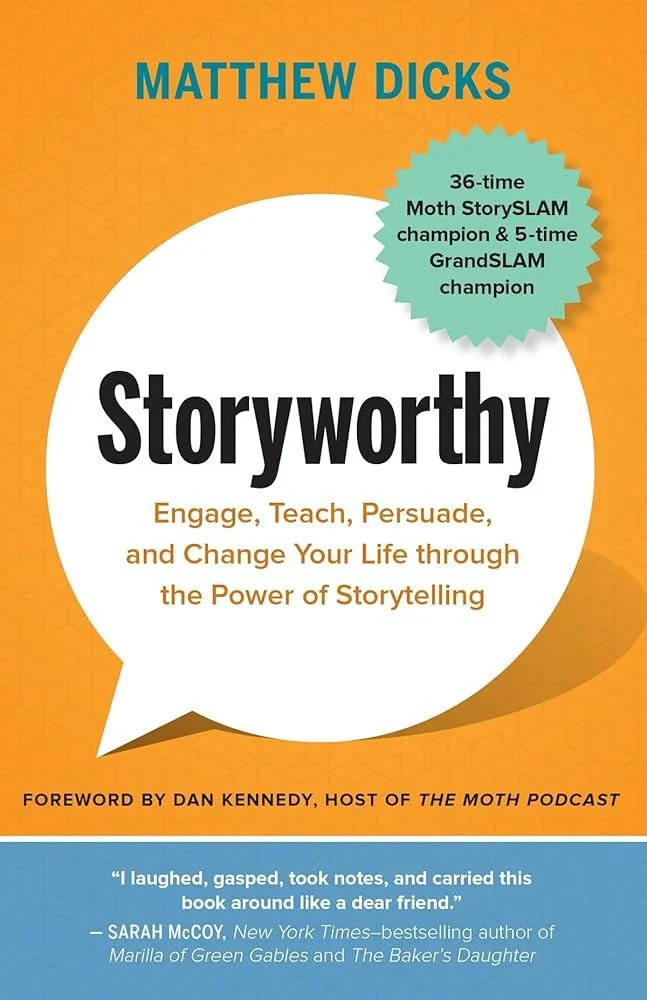
We cycle through different forms of speaking. From January–March 2026, we’re doing personal stories that actually land. We’re borrowing from the work of the master storyteller Matthew Dicks, author of the book Storyworthy.
The book is so, so, SO good. It tells you how to make an anecdote grab someone’s attention, hold it, and use it to communicate something powerful.
How much does this cost?
It’s free free free free free.
We’re a bunch of nuts who love doing this, and like to keep ourselves sharp.
What isn’t this?
We’re here to work on improving our communication — so this isn’t a support group or a networking group.
Q: This sounds like Toastmasters. Is it Toastmasters?
It’s not — but it is inspired by it! We’re huge fans of the Toastmasters, but we’ve made this an independent group. (This gives us the freedom to innovate.)

Our agreement
If you show up regularly, we’ll help you strengthen your strengths and weaken your weaknesses. We only ask that you do the same for us.
Q: What if I don’t know my strengths and weaknesses in communication?
We’re happy to help — but we’ll never tell you what you need to do.